New findings on adaptive strategies of sympatric oaks along climate gradients in China
Exploring the coexistence mechanisms of sympatric closely related species along climate gradients is crucial to predicting shifts in species distribution and community assembly. Previous studies mainly focus on the differentiation of specific functional traits, but scarcely explore the trait variability and their coordination with plant trait networks and ecological strategies along climatic gradients, limiting this understanding of coexistence mechanisms in sympatric species with wide geographical ranges.
Researchers from the Restoration Ecology Group in South China Botanical Garden, Chinese Academy of Sciences, studied the interspecific and intraspecific variations in plant functional traits, the topology of plant trait networks, and the ecological strategies of two sympatric oak species (Quercus acutissima and Q. variabilis) across temperate and subtropical forests in China. They found that nine among the 15 studied functional traits differed significantly between the two oaks; the two oaks exhibited similar intraspecific variability, but diverged trait-level variability, with Q. acutissima showing lower morphological but higher physiological variability than Q. variabilis;the connectivity and complexity within trait correlation networks of the two oaks covaried across favorable temperature ranges, but diverged at low and high temperatures as well as along precipitation gradients; both the oaks adopted competitive and stress-tolerant ecological strategies; however, Q. variabilis were more competitive but less stress-tolerant than Q. acutissima when growing at their distribution edges.Those findings imply local divergent and convergent adaptation of the sympatric oaks via altering trait-level plasticity and trait integration along climate gradients, potentially leading to greater niche differentiation and complex community assembly.
The results titled by “Sympatric oaks exhibit local divergence and convergence in adaptive strategies along climate gradients” was published in Plant, Cell & Environment. Article link: https://doi.org/10.1111/pce.70742
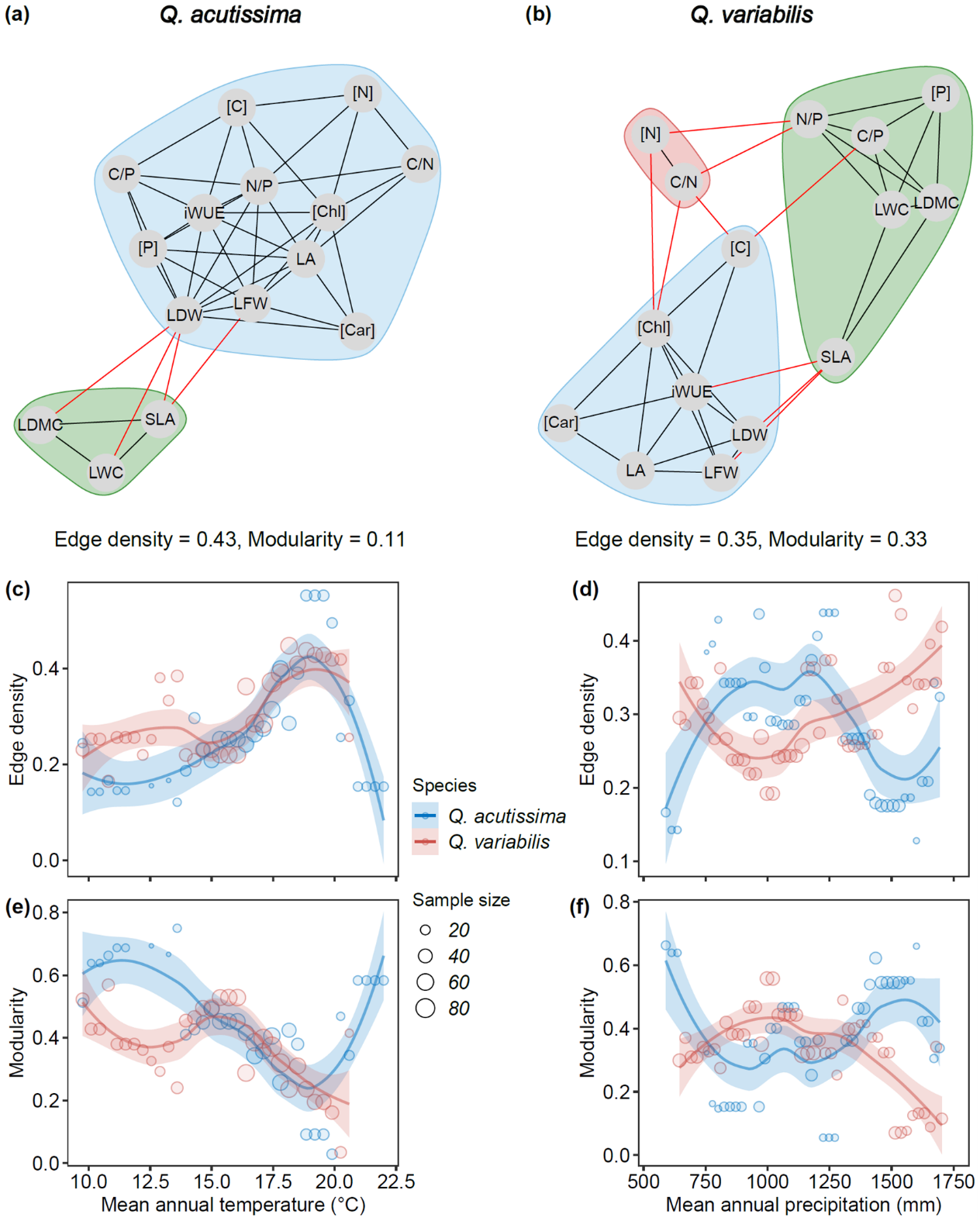
Figure. Plant trait networks of Quercus acutissima and Q. variabilis, and variation in edge density and modularity of plant trait network along climate gradients.(Image by LAI Yuan)
File Download: