Restoration Ecology Research Team Reveals Interspecific Variation in Minimum Leaf Conductance Among Dominant Woody Species in Subtropical Forests and Its Key Drivers
Global climate change has profoundly altered terrestrial plant water relations. In particular, shifts in precipitation regimes, rising temperatures, and increasingly frequent extreme drought events pose serious challenges to plant growth and survival. Minimum leaf conductance (gmin) characterizes the rate of water loss after stomatal closure and is closely linked to plant performance and survival under extreme drought. Previous studies have shown that gmin differs significantly among species, yet the key factors driving interspecific variation in gmin across different functional groups (e.g., light-demanding vs. shade-tolerant species) remain unclear.
Researchersfrom the Restoration Ecology Research Team at the South China Botanical Garden, Chinese Academy of Sciences, investigated 39 dominant woody species from a south subtropical evergreen monsoon broadleaved forest, spanning two functional groups: light-demanding and shade-tolerant species. By measuring related leaf traits and conducting modeling analyses, the team found that cuticle thickness was the primary factor explaining variation in minimum leaf conductance. Specifically, light-demanding species tended to have thinner cuticles and a higher proportion of stomatal distribution, resulting in significantly higher gmin than shade-tolerant species (Figure 1). Light-demanding species also achieved more efficient carbon acquisition through higher photosynthetic rates, but at the cost of greater risk of water deficit. In contrast, shade-tolerant species adopted a more conservative water-use strategy, characterized by thicker cuticles and a lower proportion of stomatal distribution. These results further support the existence of a trade-off between carbon gain and water use in plants.
This study demonstrates coordinated shifts among leaf anatomical structure, minimum leaf conductance, and carbon acquisition capacity across functional groups driven by contrasting light-requirement strategies, providing new insights into forest plant drought responses and adaptation under climate change. These findings have been published in Journal of Experimental Botany under the title “Minimum leaf conductance varied across 39 sub-tropical woody species with contrasting light requirement strategies”. This work was supported by the National Natural Science Foundation of China, and Guangdong Science and Technology Plan Project. Article link: https://doi.org/10.1093/jxb/eraf318
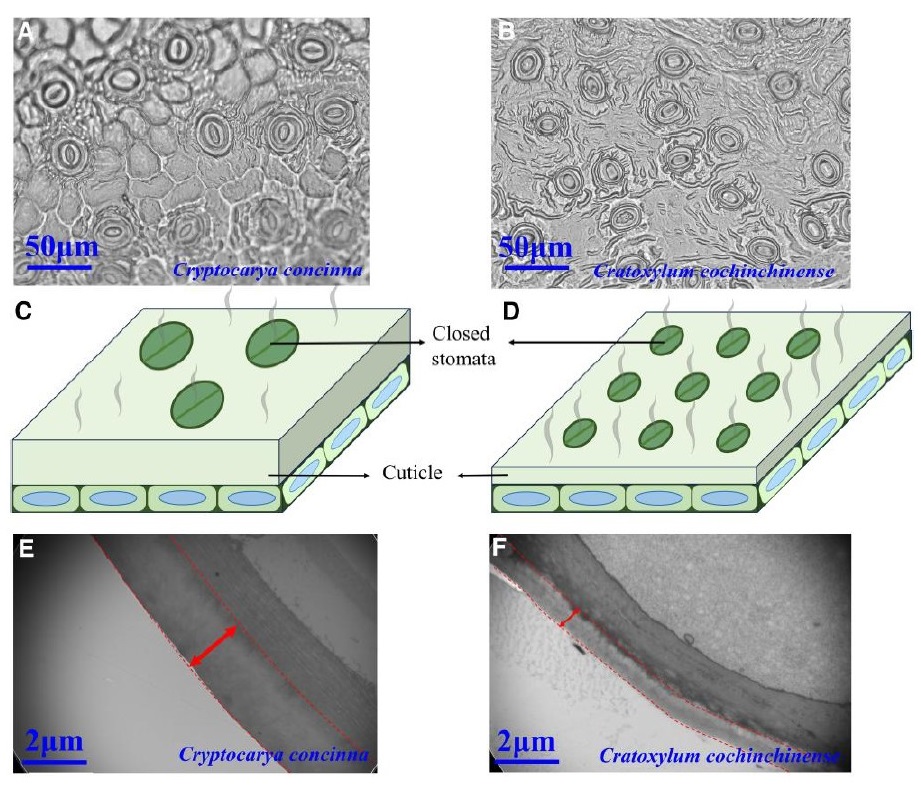
Figure. 1. Conceptual model showing the co-variation between cuticle thickness and fraction of epidermis allocated to stomata. (A, C, E) Shade-tolerant species invest in thicker cuticle and there is a lower fraction of epidermis allocated to stomata. (B, D, F) Conversely, light-demanding species tend to present a thinner cuticle and higher fraction of epidermis allocated to stomata. Transmission electron microscopy and optical microscope images reveal the cuticle thickness of the adaxial side (Tc-adaxial) and stomatal distribution in Cratoxylum cochinchinense (a light-demanding species) and Cryptocarya concinna (a shade-tolerant species). Red dashed lines indicate the edge of the cuticle and red triangles indicate the thickness of the cuticle.(Image by LIAO et al.)
File Download: